
Indian benchmark equity indices, Sensex and Nifty, rallied in early trade, driven by positive global market trends and easing crude oil prices, despite the US Federal Reserve's hawkish stance tempering overall sentiment. Track Sensex, Nifty on September 18.

Trade negotiations between the United States and Canada have collapsed, leading to the US imposing 50% tariffs on nearly $28 billion worth of Canadian imports, with Canada immediately vowing to retaliate dollar-for-dollar.

US Secretary of State Marco Rubio stated he does not believe India and Iran are pursuing a trade deal, despite a recent meeting between their leaders. He acknowledged that many countries engage with the Iranian regime but reiterated President Trump's warning against helping Iran evade sanctions, threatening penalties for nations that do so.
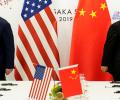
Top US and Chinese officials, including Vice Premier He Lifeng and Treasury Secretary Scott Bessent, held "candid, in-depth and constructive" talks in New York on economic and trade issues, with a specific focus on artificial intelligence. These discussions precede Chinese President Xi Jinping's anticipated visit to Washington and occur amidst new US sanctions targeting countries purchasing Russian oil and gas, and the US unveiling an "AI Force."

China has strongly rejected a US bill that would impose tariffs on countries, including India, for purchasing Russian oil and gas. Beijing views the "Lindsey O Graham Sanctioning Russia and Iran Act 2026" as an act of "long-arm jurisdiction" and interference in its sovereign trade relations, asserting that its economic cooperation with other nations is based on equality and mutual benefit.

India has stated its commitment to protecting its economic interests and ensuring energy security after the US House of Representatives passed a bill allowing the US President to impose tariffs of up to 100 per cent on countries, including India and China, for purchasing Russian crude oil. The Ministry of External Affairs affirmed India's resolve to maintain diversified energy sourcing and has articulated its concerns to US interlocutors regarding the bill's potential implications.

Former Rajasthan chief minister Ashok Gehlot has criticised the Centre for introducing a 0.4% charge on UPI transactions above Rs 2,000, alleging the decision was influenced by pressure from the United States and its payment companies like Visa and Mastercard. He highlighted a perceived shift in the government's stance on Merchant Discount Rate (MDR) for UPI, claiming it would ultimately burden consumers and small businesses while benefiting American firms.

The Reserve Bank of India (RBI) maintained its key policy rates for the fourth consecutive time, keeping the repo rate at 5.25 per cent, while the benchmark BSE Sensex closed 152 points higher in a volatile session, recovering from an intraday dip.

India's proposal to link BRICS payment systems, including central-bank digital currencies (CBDCs), was notably absent from the grouping's New Delhi Declaration, despite being a key agenda item for India's chairmanship. This omission leaves the 16-year effort for trade in local currencies without a settled payment architecture, with the declaration only 'acknowledging' the work of the BRICS Payment Task Force.

Iranian President Masoud Pezeshkian declared that Iran will not succumb to "bullying" from the US and Israel, vowing to protect national interests amidst escalating West Asian hostilities. During his visit to New Delhi for the BRICS summit, Pezeshkian also discussed strengthening bilateral ties with Prime Minister Narendra Modi and advocated for local currencies in BRICS trade, positioning Iran as a strategic energy and transport partner.

External Affairs Minister S Jaishankar met his Chinese counterpart Wang Yi in Manila, reiterating that peace and tranquillity in border areas are prerequisites for normal India-China relations. He stressed the importance of mutual respect, interest, and sensitivity, while also raising concerns about market access, trade imbalance, and supply chain uncertainties.

The CPI and CPI(M) have announced they will contest one Assembly segment each in the upcoming Tamil Nadu bypolls, while continuing their outside support for the ruling TVK. This decision creates a five-cornered contest and highlights the Left parties' independent stance, aimed at preventing indirect BJP influence and addressing public issues.

During the 18th BRICS Summit in New Delhi, Chinese President Xi Jinping and Prime Minister Narendra Modi held a bilateral meeting, outlining a four-point approach for the steady and long-term development of China-India relations. The leaders stressed strategic understanding, win-win cooperation, mutual respect, and inclusive multilateral engagement, reaffirming their commitment to resolving the boundary question and addressing economic concerns. They also discussed global challenges and strengthening people-to-people ties.

External Affairs Minister S Jaishankar visited Kyiv, reiterating India's readiness to assist in ending the Ukraine-Russia war. He emphasised that solutions would not emerge from the battlefield and highlighted Prime Minister Modi's call for an end to the conflict. Discussions also covered humanitarian aid, the impact on commercial shipping, and bilateral trade, with Jaishankar inviting his Ukrainian counterpart to India for further talks.

Gold prices in India extended their losing streak, falling by Rs 1,500 to Rs 1,60,900 per 10 grams, influenced by hawkish remarks from Federal Reserve Chair Kevin Warsh and rising oil prices, which have increased expectations of an interest rate hike.
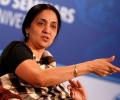
The Supreme Court has refused to quash proceedings under the Prevention of Corruption Act against former NSE MD and CEO Chitra Ramkrishna, stating that the trial court will determine whether she can be considered a 'public servant' under the Act.

The Congress party has criticised the government's new 0.4% charge on UPI transactions above Rs 2,000 for merchants, terming it a "Modi tax". Opposition leaders, including Rahul Gandhi and Mallikarjun Kharge, allege that this move will ultimately burden consumers through price hikes and accuse the government of succumbing to American pressure to dilute India's zero-MDR policy. The government states the charge will support banks and fintechs.

The Congress party has accused the Modi government of succumbing to US pressure by introducing a 0.4% Merchant Discount Rate (MDR) on UPI transactions over Rs 2,000 for merchants. The party alleges this move aims to benefit US card companies and links it to broader US actions against India, including tariffs and H-1B visa issues. The government, however, clarifies that consumers will not be charged.

External Affairs Minister S Jaishankar stated that India is in continuous dialogue with both Ukraine and Russia, seeking ideas and suggestions to mitigate or cease the ongoing conflict. Following his visit to Kyiv, Jaishankar reiterated India's stance that the war must end through dialogue and diplomacy, emphasising that trade decisions like oil purchases are not the solution to the conflict.

The UK has announced a comprehensive sanctions regime against Israeli settlements in the West Bank, banning the import of goods and targeting entities involved in settlement expansion. Foreign Secretary Ed Miliband condemned the "ethnic cleansing of Palestinians" and highlighted international support for the UK's stance, while Israel reacted strongly with counter-measures.

Indian benchmark indices, Sensex and Nifty, saw declines in early trade, with the ongoing US-Iran standoff cited as a major factor impacting investor sentiment and raising concerns about inflationary pressures and currency volatility for oil-importing nations like India. Track Sensex, Nifty on August 14, 2026.
The Finance Ministry has refuted allegations that US pressure influenced the decision to levy a 0.4% Merchant Discount Rate (MDR) on select UPI payments. It clarified that NPCI guidelines prioritise RuPay credit cards on UPI to foster a domestic payment ecosystem and that the MDR introduction aims to create a sustainable revenue model for smaller domestic companies, thereby protecting India's sovereignty in digital payments.

Bangladesh is considering joining a newly formed defence alliance between Saudi Arabia, Pakistan, and Turkiye, with junior ministers stating that any decision would be based on national interests and a "Bangladesh First" policy. The pact, signed in Makkah, aims for collective deterrence.

Chinese Foreign Minister Wang Yi stated that President Xi Jinping and Prime Minister Narendra Modi reached a crucial consensus during the BRICS summit, agreeing that China and India should be partners, not rivals. The leaders pledged to maintain peace and tranquility in border areas, deepen cooperation, and support each other in multilateral forums, aiming to strengthen the Global South and promote a multipolar world order.

Indian benchmark indices, Sensex and Nifty, saw early gains driven by lower crude oil prices and buying in Reliance Industries, even as the Reserve Bank of India maintained its benchmark policy rate for the fourth consecutive meeting, reinforcing confidence in the domestic economy.

The Securities Appellate Tribunal (SAT) has dismissed Ketan Parekh's appeal challenging Sebi's denial of his request to cross-examine two traders from Capital Group, related to an alleged front-running scheme.
Indian benchmark equity indices, Sensex and Nifty, closed lower due to persistent geopolitical tensions in the Middle East and elevated crude oil prices, with investors remaining cautious ahead of fresh US sanctions on Iran.

The Indian government has introduced a 0.4% fee on UPI transactions above Rs 2,000 for merchants, effective October 15, sparking strong opposition from political parties and traders. Despite accusations of foreign influence and demands for a rollback, the finance ministry and top functionaries have stated there will be no reversal, citing the need for a self-sustaining digital payments ecosystem.
The Congress party has accused the Indian government of imposing new charges on UPI transactions due to pressure from the United States, specifically to benefit American card companies. The opposition party demanded the withdrawal of the decision, calling it "anti-national" and alleging it fills the coffers of US firms while burdening Indian citizens. The government, however, clarified that the Merchant Discount Rate (MDR) charges apply only to commercial transactions above Rs 2,000 and are not levied on consumers, a stance supported by the BJP which accused Congress of spreading "fake news".

Iranian President Masoud Pezeshkian concluded his visit to India for the 18th BRICS Summit, announcing that Iran and the UAE agreed to move past previous tensions. This diplomatic breakthrough occurred during talks with Abu Dhabi's Crown Prince on the summit sidelines. Pezeshkian also met with PM Modi to discuss bilateral ties and West Asia developments, with Modi emphasising dialogue for regional peace. The BRICS summit adopted the New Delhi Declaration 2026, calling for global governance reforms and de-escalation in West Asia.

Prime Minister Narendra Modi urged Russian President Vladimir Putin to move from 'endless war to the end of war' in Ukraine, emphasising that a peaceful resolution is humanity's shared priority.

Analysts predict that geopolitical developments, particularly surrounding the Strait of Hormuz and the US-Iran standoff, along with crude oil prices, will be the primary factors influencing stock market movement in the coming week. Investors will also monitor foreign institutional flows and the Federal Open Market Committee (FOMC) minutes for signals on the Federal Reserve's policy outlook.

Indian benchmark indices, Sensex and Nifty, experienced declines in early trade due to a significant spike in crude oil prices, driven by escalating geopolitical uncertainties, despite positive cues from Asian and US markets.

The Reserve Bank of India (RBI) has maintained its benchmark policy rate at 5.25 per cent for the fourth consecutive meeting, prioritising clarity on inflation trends, particularly concerning energy costs and geopolitical developments.

Authorities in Jammu demolished two residential houses belonging to alleged drug peddlers as part of an intensified crackdown on narcotics trafficking and illegal assets. This action follows legal procedures and targets individuals involved in multiple drug-related cases, aiming to disrupt criminal networks and combat the drug menace.
Indian stock market indices closed on a mixed note, with the Sensex gaining 374 points driven by buying in Reliance Industries and ICICI Bank, while the Nifty remained flat. This divergence is attributed to a new Closing Auction Session (CAS) mechanism introduced by stock exchanges, impacting market liquidity and price discovery.

Prime Minister Narendra Modi, addressing the SCO summit in Bishkek, called for a united front against terrorism and its financing, rejecting double standards. He emphasised resolving conflicts through dialogue and diplomacy, not battlefields. Modi also highlighted that connectivity projects must respect national sovereignty and territorial integrity, a veiled reference to China's Belt and Road Initiative. India's vision for SCO rests on security, connectivity, and opportunity.
HDFC Bank's share in active mutual fund schemes has fallen to multi-year lows, despite overall MF ownership in the bank rising, as the stock faces weak performance, soft margins, and governance concerns.

New Delhi must look for formal, institutional statements issued directly from Washington rather than rely on casual pronouncements meant for local audiences, notes Ambassador Rajasekhar.

Tamil Nadu Minister C T R Nirmal Kumar has rejected calls for an all-party meeting to discuss the ongoing Cauvery water dispute with Karnataka, citing a previously passed unanimous resolution in the Assembly. He accused DMK and Karnataka CM D K Shivakumar of working against Tamil Nadu's interests and criticised the DMK's "hasty" Supreme Court petition.
